
Artists use different techniques to give images depth, and make them vivid. In this assignment we literally let the work come to the fore by working in layers.
Relief
There are several ways to create depth. Some of these you have already learned, for example how to apply shadows. There are also other ways you can create depth. An example of this is creating relief.
Relief literally means difference in height. By applying relief in your work, you make differences between high and low parts, creating a depth effect.
Relief in art
The Greeks and Romans made extensive use of relief in art. You can see this especially in the buildings from that time. On these buildings, representations were carved on the flat surface. By removing more stone on some parts than on other parts, you got a difference in height. You can see some examples in figure 1.
Relief was not only used in art during the time of the Greeks and Romans. We still see it in modern art. In figure 2, for example, you see work by Jan Schoonhoven and Yves Klein. Relief is also applied in their artworks. This relief influences the spaciousness and the shadowing of the work of art.


Album 1: Example of a Greek relief (left) and a Roman relief (right)


Album 2: Various modern reliefs by Yves Klein (blue) and Jan Schoonhoven (white)
Selfie
- Take a selfie which you will use as a starting point for your project. Please note the following:
- Take the selfie straight from the front (en-face)
- Make sure your face takes up almost the entire photo, including part of your shoulders
- Make sure the top and sides of your face don't fall off the photo
- Make sure it is a sharp/clear photo
- To make your piece more interesting later on, you could show an exaggerated emotion, think of screaming, looking sad or angry
- Print the selfie on A4 paper in black and white.
Monochrome and polychrome color use
Monochrome
At home you went looking for brown cardboard or cardboard of different shades of brown. You will soon receive a portrait that is made only of brown tones. Working with almost one color in your work is called monochrome use of color.
Polychrome
The opposite of monochrome is polychrome. When using polychrome color, several different colors are therefore visible.
In photo album 3 you see both a monochrome and a polychrome landscape. What is which?


Album 4: Example of a monochrome and a polychrome landscape
Different techniques
You will simplify the shape and the color will become monochromatic. Nevertheless, your piece of work can become interesting by using different techniques. Before you start, think about different techniques you can use. This creates structures and textures that will make your work lively. You can think of creasing, curling, tearing, cutting, notching, and all kinds of things that you might come up with yourself.
Figure 4 shows examples of different techniques. You can use these techniques, but of course you can also come up with one or more other techniques yourself!
In figure 5 you can see examples of how these techniques have been applied to create a special portrait, just like you will now do yourself!
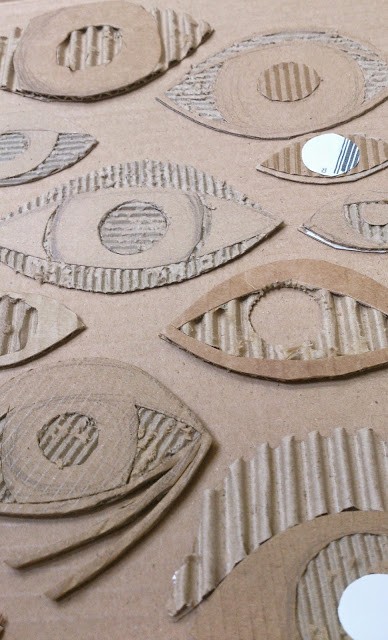

Album 4: Different embossing techniques with cardboard


Album 5: Examples of Cardboard Portraits
Cardboard portrait
Take your selfie as a basis and make a self-portrait out of cardboard. Start by cutting out your silhouette and transferring it to a cardboard surface. Then add several layers to create relief. Use several layers of cardboard to accentuate higher areas, such as the nose.
Assessment criteria
- Your portrait is made up of at least 4 different layers
- You are recognizable in your self-portrait
- You have used at least 3 different techniques
- Your piece of work uses monochrome color